


By nature, I am curious and gravitate toward experiences that are physically and mentally challenging. A few years back, when Chitra (my wife) spoke about Vipassana, I was intrigued. What resonated with me was the idea of a 10-day silent meditation course. In 2019, I made an unsuccessful attempt, but the thought continued to linger within me. In 2025, when I turned 50, as a way of doing something special (!), I registered for the course again.
From not being able to meditate for even 10 minutes, I successfully completed the 10-day Vipassana course, during which we meditated for 10.5 hours every day.
The 10 days were physically and mentally challenging—often boring. Many times, I questioned myself: Why am I subjecting myself to this? Yet every time I felt I had hit rock bottom, something transformational would happen. That experience would lift me just enough to carry me through the next 24 to 48 hours. For me, those transformational moments occurred on Days 3, 5, and 7.
I share my Day-3 experience below, along with answers to some common questions I’ve received from friends, colleagues, and customers. I hope this encourages you to be a better observer in life and to remember that every phase—good, bad, or ugly—shall pass.
Day-3 Vipassana Experience: Fireflies, Two Nails & a Fly
Context Setting
In 2022, while walking Bambi (our furry boy), he was attacked by a larger dog. It took me around 20 seconds to grab hold of the other dog’s collar and pin him. But in those 20 seconds, Bambi was bitten on his right hind leg, his belly, and his right shoulder area.
In June 2025, during summer break, some kids in our neighborhood were engaging in “ding-dong-dash” routines. These had occurred in the past and were usually brushed off as harmless pranks. This time, however, the group escalated things by encroaching onto private property beyond doorbells, eventually leading to the police being called. On one such night, after speaking with the police, one of us remarked jokingly, “And look at our guard dog—he’s doing such a good job!” Bambi had been lying inside the house and hadn’t reacted to the commotion at the front door.
In July 2025, we made the difficult decision to say goodbye to Bambi. The vet administered a sedative injection, followed by the euthanasia injection.
Until the last year of his life, every time I returned home from a business trip or from the office, Bambi would be waiting by the door. His excitement would peak as he jumped up to my chest. There were occasions when I would be on an official call, and my colleagues would know I had entered the house because Bambi would be “talking” to me and demanding attention. By the time I set my bag and jacket down, he would be in my arms, face to face. He would try to lick my nose and lips, and when I looked away, he would begin licking my ear—which I was perfectly fine with.
Meditation Background (Day-1 to Day-3)
On Day-1, we focused our attention on the nostril area, observing inhalation and exhalation. On Day-2, the focus expanded to the triangular area between the nose and upper lip. By Day-3, we continued focusing on this triangular area while attempting to observe sensations on the upper lip. These sensations could include tingling, prickling, itchiness, warmth, cold, or subtle energy.
Mental State Going into Day-3
By the end of Day-1, I had approached the assistant teacher about the physical discomfort and pain I was experiencing. He advised me to focus on my breath and assured me that by Day-3, the discomfort would subside. This was common, as my body was not accustomed to sitting on a meditation pillow for 10.5 hours a day.
By the end of Day-2, boredom had set in, and the process felt repetitive and physically taxing. That day, I found myself thinking, “Why am I subjecting myself to this?” I still had eight more days of this torture ahead of me.
The Vivid Dream (Night of Day-2)
On the nights of Day-0 and Day-1, I slept without dreams. On the night of Day-2, I dreamt vividly about Bambi. While I generally remember my dreams, this one—and many others during the Vipassana course—were exceptionally vivid, with every detail clearly imprinted in my mind the next morning.
In the dream, the ding-dong-dashers had just banged on our glass front door. When I opened it, I saw two adults (not kids) running away from our home at a speed I could have easily caught up to. Resisting the urge to chase them, I stood at the doorway and watched as Bambi slipped past me and ran after them.
He sprinted across our driveway and into our neighbor’s yard, where he suddenly stopped and yelped in pain. He was limping, holding his right hind leg in the air. I rushed to him and lifted him into my arms like a baby, his belly facing me. His right hind leg was bleeding, and I noticed two nails embedded in his paw. I gently removed the nails, held him tightly against my chest, and carried him back into the house.
As soon as I placed him on the floor, he began running around like the energetic Bambi we all knew. The wounds had vanished, and he dashed through the house, jumping onto the sofa in his youthful best.
Day-3 Experience
I woke up thinking about the dream I had the night before and continued thinking about it during my first meditation session from 4:30 a.m. to 6:30 a.m. Throughout this meditation, my mind kept returning to the dream and what it meant.
In my observation, Bambi chasing the ding-dong-dashers represented what he would have done during his good, healthy years. The wound marks on his right hind leg symbolized the guilt I had harbored for not being able to protect my boy during the dog attack in March 2022. The two nails I removed from his paw felt like the two injections he received from the vet on July 11, 2025. It was Bambi telling me to let go of those memories and simply cherish the many beautiful moments we shared during his 12 years with us.
For the post-lunch meditation session, I decided to meditate in my dorm room. During this session, we were observing sensations on our upper lips. Very soon, I could feel energy on my upper lip. This turned into a warm sensation that spread not only across my upper lip but throughout my entire body.
Soon, the sensation transformed into what I can only describe as tiny glowing lights around my upper lip. These lights grew stronger and warmer, resembling a sea of fireflies glowing intermittently around my lips.
As I experienced these sensations, memories of Bambi filled my mind—how he jumped up to my chest in excitement when he first came home, bouncing like he was on a mini trampoline; how he played fetch in our backyard and dashed around like a deflating balloon. The glowing sensations spread from my lips to my cheeks and then to my ears. They became so intense that it felt as though I could see beneath my skin, as if under a microscope. I could observe fluids, cells, and blood vessels. I distinctly remember noticing a fairly large blood vessel beneath my right ear, pulsing rhythmically.
In Vipassana, pleasant sensations are also considered a form of craving. Students are taught to observe them with the understanding that they, too, shall pass. But I didn’t want this experience to pass. I was fully immersed when the gong rang, signaling that it was time to move to the Dhamma Hall for group meditation. I don’t recall how long I was in that state; I simply wanted more.
Tears flowed continuously, and I went through several tissues from the well-stocked tissue box thoughtfully placed in each room. Reluctantly, I stopped my session, washed my face, and noticed in the mirror that my eyes were bloodshot red. I stuffed my pockets with more tissues and hurried to the Dhamma Hall.
I was the last to enter, and thankfully everyone was already settled. As soon as we resumed meditation, it felt like I had pressed play on Bambi’s movie once again. Happy images of him flooded my mind, and I willingly surrendered to the experience. Tears began flowing again, and my nose started running. I used all the tissues I had and became conscious of disturbing others. I quietly stepped out to the restroom in the breakout area, released more emotion, and washed my face once again.
As I stepped out, the male student manager was waiting. He whispered, “Suresh, are you in pain?” I smiled through my tears and replied, “No, I just had a memorable experience.”
We walked back into the Dhamma Hall, and this time I was more composed. I sat down to meditate, and soon a fly began buzzing around my face. I recalled S. N. Goenka mentioning in one of his evening discourses that while meditating outdoors, one must learn to ignore flies and other distractions.
The fly landed on my nose, then my lips, then my ears. It sat on my ear for a while before flying away, only to return and land on my hands and feet. This continued throughout the afternoon session. It reminded me of Bambi—licking my nose, my lips, and finally my ear. For many, this might seem like coincidence, but to me, it felt like Bambi keeping me company when I was most vulnerable. It also felt like a process of washing away past guilt and aversion.
I had similarly powerful and deeply personal experiences on Days 5 and 7. Not all of them were pleasant, but they helped me observe actions and memories from my past, some dating back more than 40 years.

Common Questions
What were your expectations from the Vipassana course?
Many of my friends have asked me this question. The honest answer continues to be: “I had no expectations.” I was curious and wanted to challenge myself with a 10-day silent meditation regime.
Are you silent for the entire 10 days?
On Day 0, when you check in, you are required to hand over all your electronic devices to the organizers. I handed over my Apple Watch, iPhone, wallet, and car keys. So you are truly cut off from the outside world.
During orientation, you are instructed to live the next 10 days as if you are alone. There is no verbal or visual interaction with fellow participants. After each meditation session in the Dhamma Hall, students are given the opportunity to approach the assistant teacher to ask questions or raise concerns. Some participants experience physical discomfort or emotional upheaval that may require attention.
There is also an option to request a private interview with the assistant teacher during the afternoon. In my case, I did not schedule any private sessions, but I did approach the teacher in the Dhamma Hall with a few questions four or five times during the course. These interactions last only a few minutes, and you are expected to whisper—or, in my case, attempt to whisper.
Is the meditation guided?
Yes. The technique is taught in small, progressive steps, and the 10-day duration is intentionally designed to accommodate even the slowest learner in the group.
Did you maintain any journal during the course?
You are instructed not to engage in any form of writing, reading, or exercise. Prior to this experience, I assumed I would have plenty of free time to ponder—but that is certainly not the case. Each day runs approximately 17.5 hours, from the 4:00 a.m. wake-up gong to lights out at 9:30 p.m., and includes 10.5 hours of meditation.
The center operates on a precise schedule, down to the minute. In reality, there is a constant hustle from one session to the next. By 9:30 p.m., you are genuinely looking forward to sleep and rest.
Can I do a shorter course?
All new students are required to complete a 10-day course to begin. Returning or “old” students, however, have the option to participate in shorter courses.
How was the food?
This was one of the most popular questions—especially from those who know I am a foodie.
The center, which is entirely run by volunteers, served breakfast at 6:30 a.m., lunch at 11:00 a.m., and supper at 5:00 p.m. Students were instructed not to carry any food into their dormitories.
All meals were vegetarian, and to the best of my recollection, accommodations were available for those with nut or dairy allergies. Breakfast was fairly consistent each day: oatmeal, a warm prune dish, bread, peanut butter, jelly or jam, three types of cereal, milk, soy milk, and tea.
Lunch varied daily and typically included a lentil dish or soup, roasted vegetables, rice, salad, and assorted condiments. Occasional baked desserts or chocolate surprises were presented. Fresh fruit at supper was provided only for new students. Old students did not eat anything after lunch.
How much did the course cost?
The course itself is free. As long as you are registered and can get yourself to the center, there is no fee.
Vipassana centers operate as non-profit organizations and rely entirely on donations from students who have successfully completed at least one 10-day course. At the end of the program, S. N. Goenka encourages students to do four things: volunteer time, send blessings during daily meditation, make a donation if possible, and share the experience with others.
This model appears to be working well, as there are centers around the world and participation continues to trend upward.
Which center did you attend?
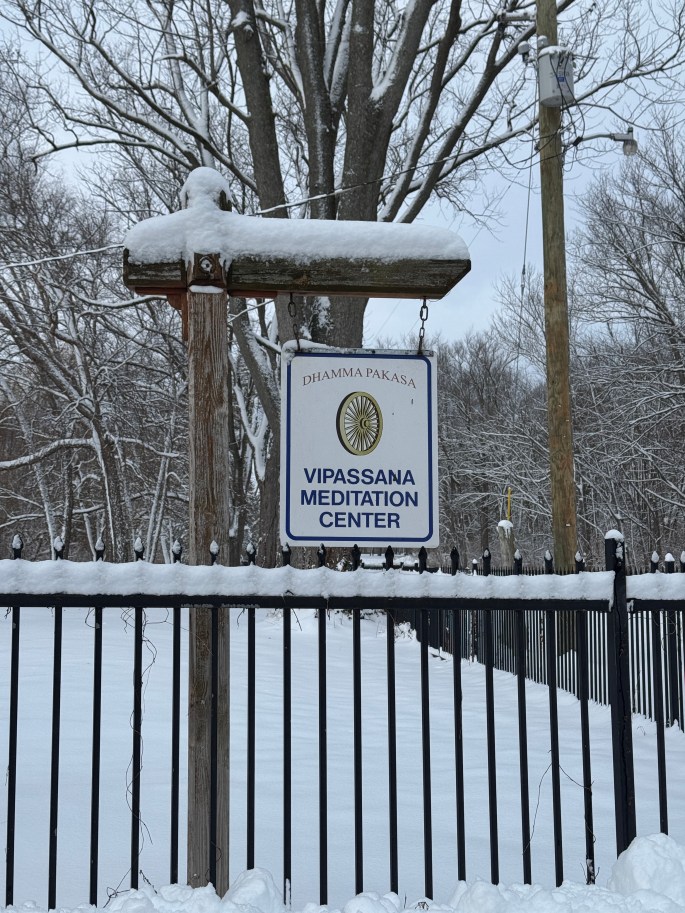
There are many Vipassana centers across the United States. I was fortunate to attend the center in Pecatonica, Illinois, which is about a two-hour drive from the Chicagoland suburbs.
What were the boarding facilities and comfort like?
Facilities vary by center. The Pecatonica center had a long dormitory divided into separate male and female sections. Each participant had a private room with a single bed, mattress, pillow, and chair. There was also a small bedside drawer containing a digital clock and a tissue box.
Each pair of rooms shared a sink, toilet, and shower. Once your application is accepted, you receive detailed instructions on what to bring. The rooms and common areas were very clean, and the fellow student with whom I shared the sink and shower was equally committed to cleanliness.
On Day 11, before leaving the center, every student participated in cleaning the three main buildings—the Dhamma Hall, Dining and Kitchen areas, and the Dormitories—to ensure the facility was spotless and welcoming for the next group.
How did you acclimatize back to normal life after the course?
After the first five hours on Day 10, participants were allowed to begin speaking again—within their gender groups. That was when I learned the name of the student in the room next to mine, and we began sharing our experiences with others.
That half day, along with the morning of Day 11, helped get our vocal cords working again. Personally, I felt unusually thirsty and drank a lot of water, but experienced no other issues.
Would you do this course again?
Stepping away from loved ones and work or business commitments for 10 days is a significant decision. I was fortunate to have a supportive family, employer and customers. My course coincided with the holiday season—from November 19 to November 30, 2025.
I would likely not repeat the course during my active corporate years. However, I do plan to volunteer once a year after I retire from corporate life.
Is there a teacher present throughout the course?
S. N. Goenka is the primary teacher. Although he passed away in 2011, the course is structured around his audio and video recordings from the 1990s.
Each course also has an assistant teacher who facilitates the sessions and addresses student questions or concerns. It is this assistant teacher whom students approach throughout the course.

Conclusion
I’ll conclude with S. N. Goenka’s words on sensations and our cravings or aversions to them—and how these leave mental formations in our body and mind.
Imagine writing on water with your finger. The writing appears briefly and disappears. This is how mental formations should behave if we live each moment as a true observer. Writing on sand or mud lasts longer but still fades. When you carve into rock with a chisel and hammer, the markings endure for years or even generations—yet even they eventually can disappear.
Vipassana is a technique that helps wash away these mental formations. The more we practice, the deeper the cleaning we can achieve.
Bhavatu Sabba Maṅgalaṁ (May all beings be happy).
Related data points:
For course details and registrations (https://www.dhamma.org/en-US/index)
My ode to Bambi (https://shantatman.com/2025/08/17/oh-bambi-our-boy/)

 SHANT ATMAN